


The Magnox plant at Hunterston required high-integrity mechanical handling solutions for the safe and reliable retrieval, manipulation, packaging and transport of Intermediate Level Waste (ILW).
Various waste boxes and drums, each posing their own unique challenges, needed to be handled in a manner that met demanding Safety Cases. And all in processing environments that carry operator exposure risks, so automation and remote control was a prerequisite.
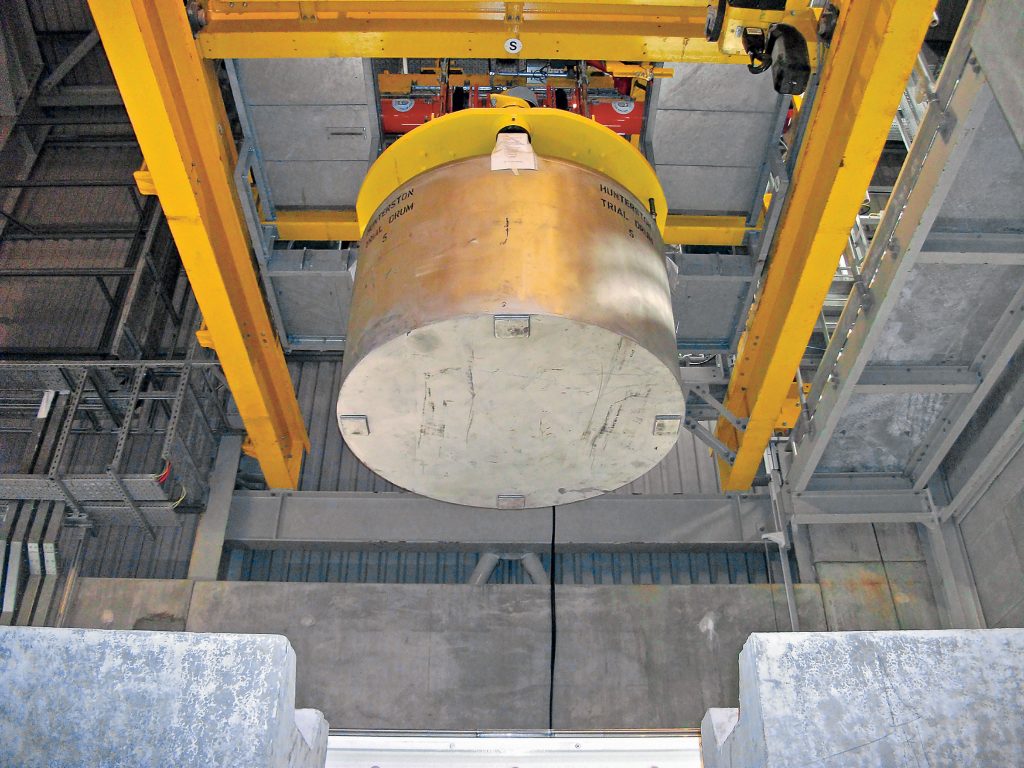
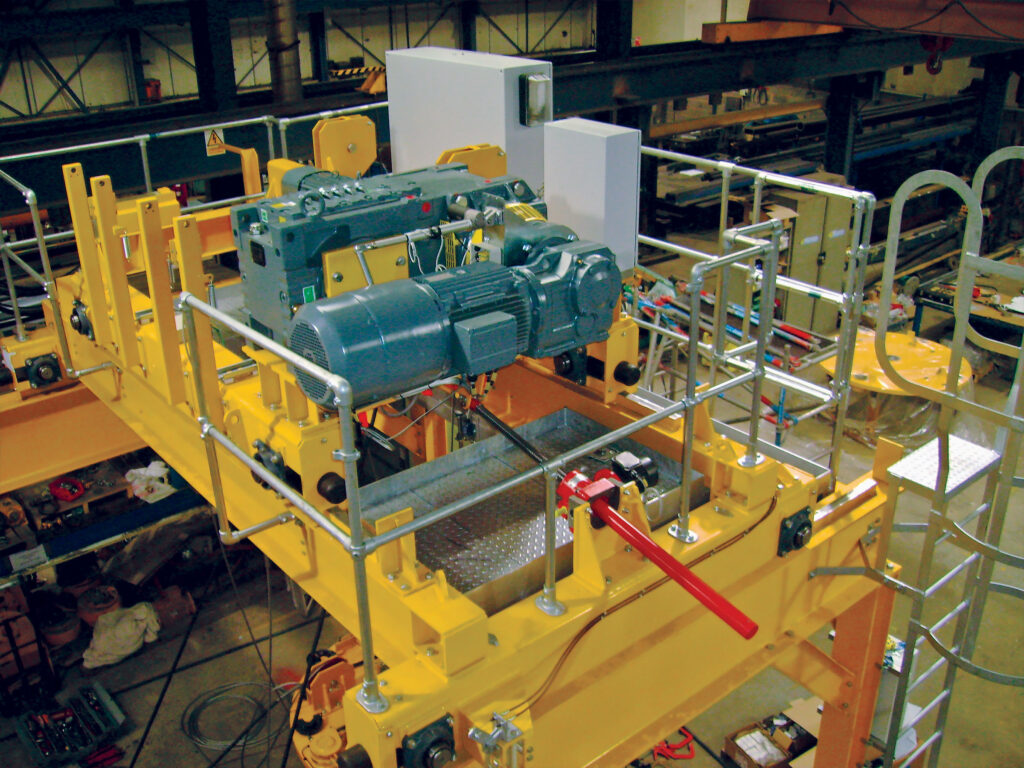
SCX designed, built, tested and installed three handling solutions, each tailored to the differing requirements of Hunterston’s ILW packages and their processing environments.
Each crane has a bespoke motorised rotating grapple, with one carrying a remote-controlled mast for entering ILW sludge ponds to safely retrieve and package waste materials. The cranes demonstrate our capability to engineer and deliver safe, reliable handling solutions for nuclear licensed sites.
The bespoke grapple engages with either ILW boxes or drums via four twist lock sockets
The package is then held in a preset position for swabbing, then lowered into a cross-site transporter vehicle for transfer to the storage facility
Limit switches, load cells, proximity switches and photocells provide advanced EC&I monitoring and millimetre precision
Fine electrical control, precise mechanical design and laser positioning ensure millimetre accuracy
Our bespoke grapple design interfaces with either Nirex boxes or drums, complete with a sophisticated locking detection system with visual confirmation flags for safety
The system uses semi-automated positioning presets, all controlled remotely via a CCTV-fed desk
The innovative latching and rotating grapple engages via twist locks into a common socket interface used on a range of ILW packages
The chassis of the crab is carefully planned to mount cabinets and cabling, and to provide easy maintenance access
SCX’s EC&I design employs load cells, encoders and limit switches, sending real time data back to the operator and detecting potential safety issues
SCX engineered four bespoke systems for Hunterston’s wet ILW handling:
The systems work together along a 14-metre shielded ‘canyon’ to retrieve waste, fill and seal the ILW packages, then position them for site transfer
Cranes for waste handling require shorter design working lives – five years in this case – enabling us to create more cost-effective, fit-for-purpose solutions
This is the main hoist for solid ILW handling, with a 10-tonne SWL, and four wire ropes to give true vertical lift
A 7-metre height of lift is inverter-controlled at speeds of 0.5 or 5m/min, long travel is 1 or 10m/min, while cross travel is 0.5m/min
The process of packaging wet ILW materials through multiple, connected mechanical handling stages requires SCX’s ‘full system thinking’ approach
Interfaces between each stage require careful engineering to ensure smooth transitions and risk-free operation
Preset positions are detected and interlocked with neighbouring stages to prevent accidental movements
This latest design is an evolution of the solid and wet ILW hoists, giving true vertical lift and a 12-tonne SWL
With a 12-metre height of lift, raise speeds are 0.5 to 5m/min with long travel speeds of 1 to 10m/min
Inverter-controlled movements deliver smooth acceleration and deceleration, reducing shock loads and sway
The crane is operated remotely via an HMI, which provides a CCTV feed and control over a range of semi-automated preset positions
Radio pendants are provided for closer control and maintenance, with operations protected by key interlocks
Diverse recovery mechanisms allow the load to be secured event in the event of a hoist failure or loss of power
The cranes are able to be recovered remotely in the event of a hoist or power failure, ensuring that no personnel need to access the area when an ILW package is present
Interlocks are used to restrict hoist and grapple operations outside of defined safe areas
Even with the complete failure of one rope, the load is held secure and level